9 july, 2009 19:53
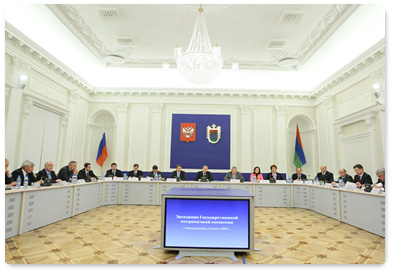
Prime Minister Vladimir Putin who is on a working visit to Karelia, chaired a meeting of the State Border Commission in Petrozavodsk


Prime Minister Vladimir Putin who is on a working visit to Karelia, chaired a meeting of the State Border Commission in Petrozavodsk

Vladimir Putin's opening remarks:
Good afternoon.
Before we start I would like to introduce the new members in your Commission: they are the President's Plenipotentiary Representative to the Urals Federal District, Nikolai Vinnichenko, the Plenipotentiary Representative to the Far Eastern Federal District, Viktor Ishayev (who is absent for a valid reason) and Minister of Agriculture Yelena Skrynnik.
Let us get to our agenda.
Today we are to discuss a wide range of issues: the prospects for the development of the border infrastructure, the implementation of our decision to bring the customs control system closer to the state border and the parameters of a coordinated border policy in the framework of the CIS.
I believe that the problems of border security merit the closest attention. The massive resource base of these territories attracts neighbouring states. It should become the basis for broader cooperation.
You know that in business there is a notion called "a hostile takeover." Well, we should not and must not allow "hostile takeovers" in any areas of cooperation.
I would like to stress that the work in this important area should be done in close cooperation with the regional authorities, which have a deeper insight into the local situation and its specifics and are able to react promptly.
As for border cooperation, economic cooperation, humanitarian and cultural interaction, Russia is open to a close and committed partnership with its neighbours.
Simultaneously, it is necessary to continue a strategic course for comprehensive improvement of the border infrastructure in order to give it a fresh look, one that meets international standards.
Last year alone a significant amount, over 19 billion roubles, was spent on the implementation of the federal targeted programme State Border of the Russian Federation (2003-2010). At present, given the limited financial resources, I urge you to closely examine the prospects for the fulfillment of the programme.
Let me stress that the fact that the programme is to be completed next year does not mean that all the projects to equip the border will have been fulfilled. This work should continue in the framework of a new federal targeted programme until 2016.
It must include the equipment of border crossing points that will be used in the preparations and the holding of the Sochi Olympics and the APEC summit in Vladivostok. It should also include the facilities that secure the export of oil coming through the Baltic Pipeline System-2 and the East Siberia - Pacific Ocean system. These are the major infrastructure projects which we should complete in short order and which are practically in the final stretch.
Other priorities include the infrastructure and equipment of the border with Kazakhstan, China, Mongolia, Ukraine, the Arctic regions and protection of the exclusive economic zone in the Pacific Region.
In developing the system of border crossings you should bear in mind that in the post-crisis period trade will grow at a faster rate and the load on the crossing points will increase noticeably. For the moment, it is to the contrary, we see it shrinking. Trade will certainly be growing and most probably at a more rapid pace than in the former good years.
In addition, the longer-term projects to develop the border infrastructure should be tied in with the long-term plans for social and economic development of the country as a whole and its regions.
The Ministry of Economic Development has been carrying out the necessary analysis and we are going to discuss its early results.
Moving on, today we will discuss the issue of bringing customs control closer to the state border. We have already discussed this issue. Our colleague, Andrei Belyaninov, the head of the Federal Customs Service, has just reported to me the progress of this work. On the whole it is going according to schedule.
The measures envisaged by this programme will in the future substantially diminish the transport load on large Russian cities and enhance the country's economic security. The expenditures of agents in foreign trade activity will be reduced because they will be able to go through all the customs formalities right at the border.
Also, previously the cargo running between the state border and the customs control office in the interior of the country was not under practical control. Dishonest businessmen and semi-criminal elements, of course, were taking advantage of this. Now the loopholes for this "gray" business should be closed.
The federal budget outlays to implement this Concept may be cut if the public-private partnership mechanisms are used. Our task here is to pass legislation which makes such investments attractive for business.
The issues connected with the building of an integrated system of border security within the CIS are constantly within the purview of our Commission.
The priorities in this area are well-known. It is necessary to continue to harmonize the regulatory base of cooperation and eliminate all the differences and disputed problems on mutually beneficial terms. Practice shows that if we take each other's interests into account, solutions will always be found.
I still believe it is necessary to increase the teamwork and coordination between the security and the law-enforcement structures of the CIS member states in order to jointly counteract emerging threats. These threats are well known: drug trafficking and organized crime.
And needless to say, more active use should be made of Russia's potential where we have much to offer in the way of cooperation and interaction with our traditional partners. I am referring to the training of personnel for customs and law-enforcement bodies of the CIS member states according to uniform training standards, the promotion of Russian weapons and equipment to be used by the border agencies of our partners in the integration process.
Let us get down to business.